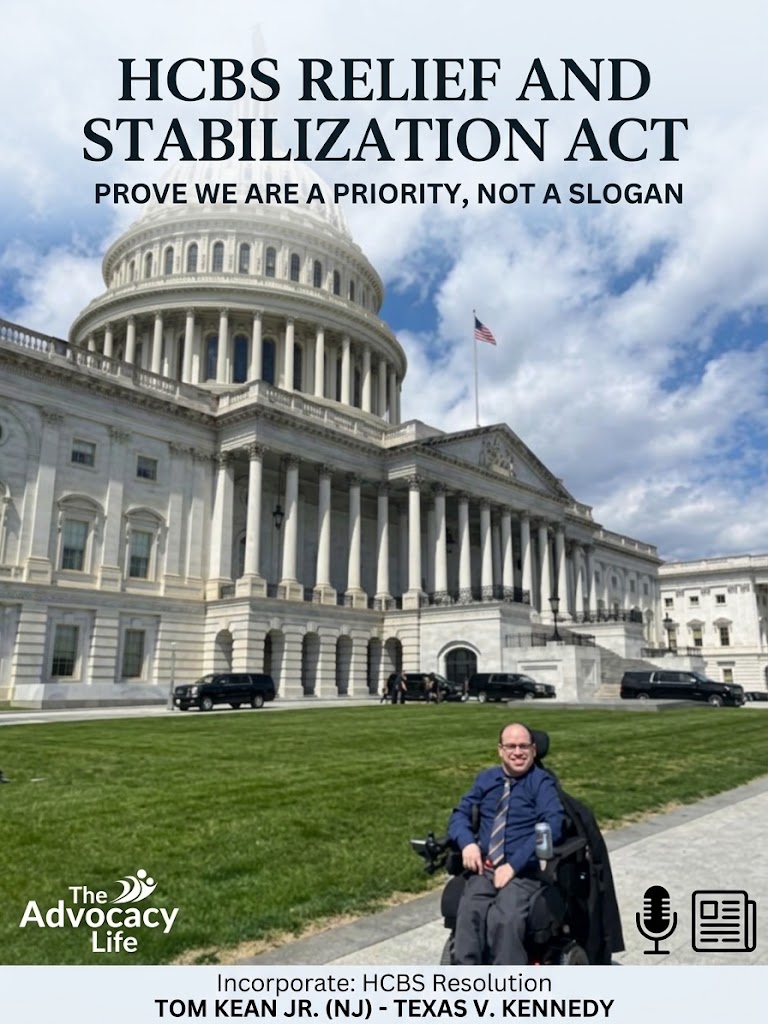
Have you heard of the HCBS Relief and Stabilization Act? Probably not.
For this week’s community blog, I want to focus on a specific piece of legislation—or rather, a resolution—that offers a big-picture view of the disability movement and examines where we truly rank in America.
For those unfamiliar, HCBS stands for Home and Community-Based Services. To oversimplify it, HCBS is a waiver care system funded by Medicaid and Medicare dollars that allows people with disabilities to stay in their homes and local neighborhoods. Regardless of age or level of need, it is always cheaper, more beneficial, and more humane for a person to thrive and function directly within their local community.
This resolution seeks to uphold and expand Home and Community-Based Services while establishing more significant safeguards for our direct support professionals (DSPs). It directly responds to legal uncertainties following filings like Texas v. Kennedy, which left critical disability care frameworks at a stalemate.
Through this resolution, members of Congress are attempting to signal to disabled voters and our population as a whole just how much we mean to them.
While this bipartisan effort is a welcome sight—notably supported by primary sponsors like New Jersey’s own Congressman Tom Kean Jr.—we cannot allow ourselves to be misled.
It is no coincidence that a resolution like this gains momentum right around election time, or that key co-sponsors are currently running for re-election. So, to politicians on both sides of the political aisle asking for our votes: prove it.
Show us that we matter. Show us that disabled Americans are a priority. Show us that we are a vital, indispensable part of this nation.
Lately, there has been a massive push in legislative halls for data centers, infrastructure developments, and commercial housing initiatives. While infrastructure is important, people come first in America. America is funded and run by the people, and people with disabilities are people first.
To Congressman Kean and all leaders stepping up: thank you for your leadership on this resolution. But to the rest of Congress: it’s time to put your priorities in order and prove that disabled America is a permanent priority, not a seasonal campaign slogan.
School starts after Labor Day in New Jersey, and as a kid, that always meant new clothes, new school supplies, and a brand-new wheelchair. This year was different. My new chair didn’t arrive until March.
The price tag on the chair I’m sitting in to write this? Nearly $60,000.
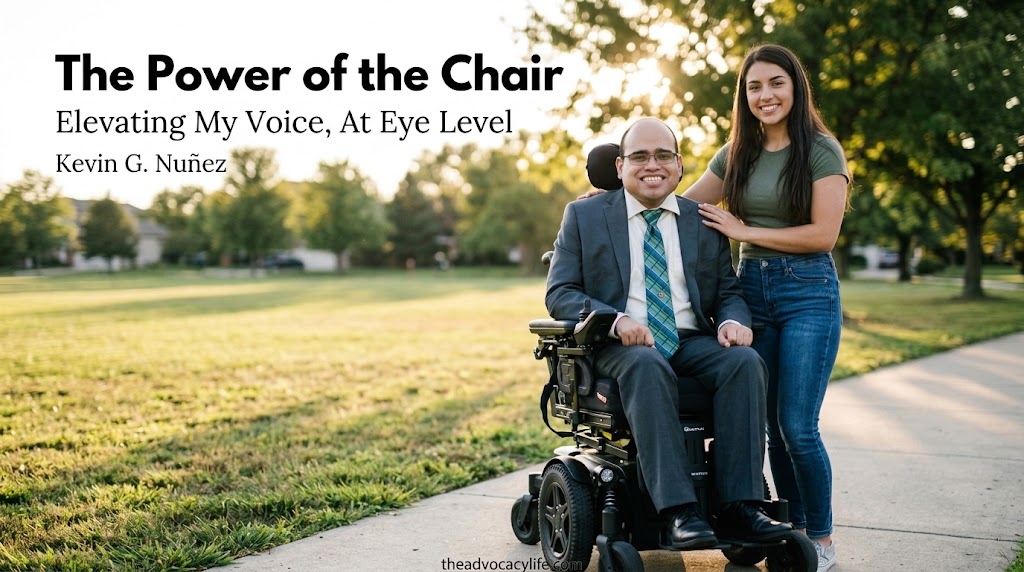
When you hear a number like that, it’s easy to do some dark math. Is $60,000 the price tag on my independence? Am I worth $60,000? Why does basic human mobility cost as much as a luxury sedan? That’s an algorithm for insurance companies and policymakers—a topic that usually sits above my advocacy pay grade. But here’s what I can tell you: this technology keeps me from being confined to a bed. It would feel unlivable. With it, I can roll out into the world, make my voice heard, and face life head-on.
For years, living in a wheelchair meant existing in a world built for vertical people. Everyone else’s chest or waist was where I always saw the world from. But this new chair comes with hydraulic elevation.
Not long ago, I was at a bar with high-top tables where everyone was standing. Typically, I’d be at a huge disadvantage, craning my neck up just to participate in the conversation. This time, I hit a button on my joystick, elevated my seat, and held a conversation at true eye level. For the first time, I wasn’t being talked down to—literally or figuratively. That single moment alone was worth the price of admission.
Since I spend at least six to eight hours a day in this chair, I’ve learned a thing or two about how the rest of the world interacts with mobility devices. For those of us who use them—and for the non-disabled allies reading this—here are a few basic ground rules:
Running someone over with a wheelchair isn’t a funny prank like in the movies; it’s the exact equivalent of hitting someone with your fist. Treat a person’s mobility equipment with the same respect you’d treat their personal space.
Wheelchairs are highly technical, custom-built, and absurdly expensive. Well-meaning people often try to grab the handles or push without asking. You could easily damage the chair or throw off the user’s balance. Always ask first.
Bodies break down, and chairs break down. They collect dust, weather, and yes, the occasional stray French fry in the cushions. Keeping a chair clean is part of the routine of staying functional.
A chair can feel restrictive at times, but so can any human body. Ultimately, it isn’t a cage; it’s a platform. It’s the tool that lets me show up to council meetings, write books, host my podcast, and advocate for our community.
Your mobility device doesn’t define your worth, but it can certainly amplify your power. Take care of your gear, demand respect for your space, and never let anyone talk down to you—no matter what height you’re sitting at. Keep on rolling. Keep on living.
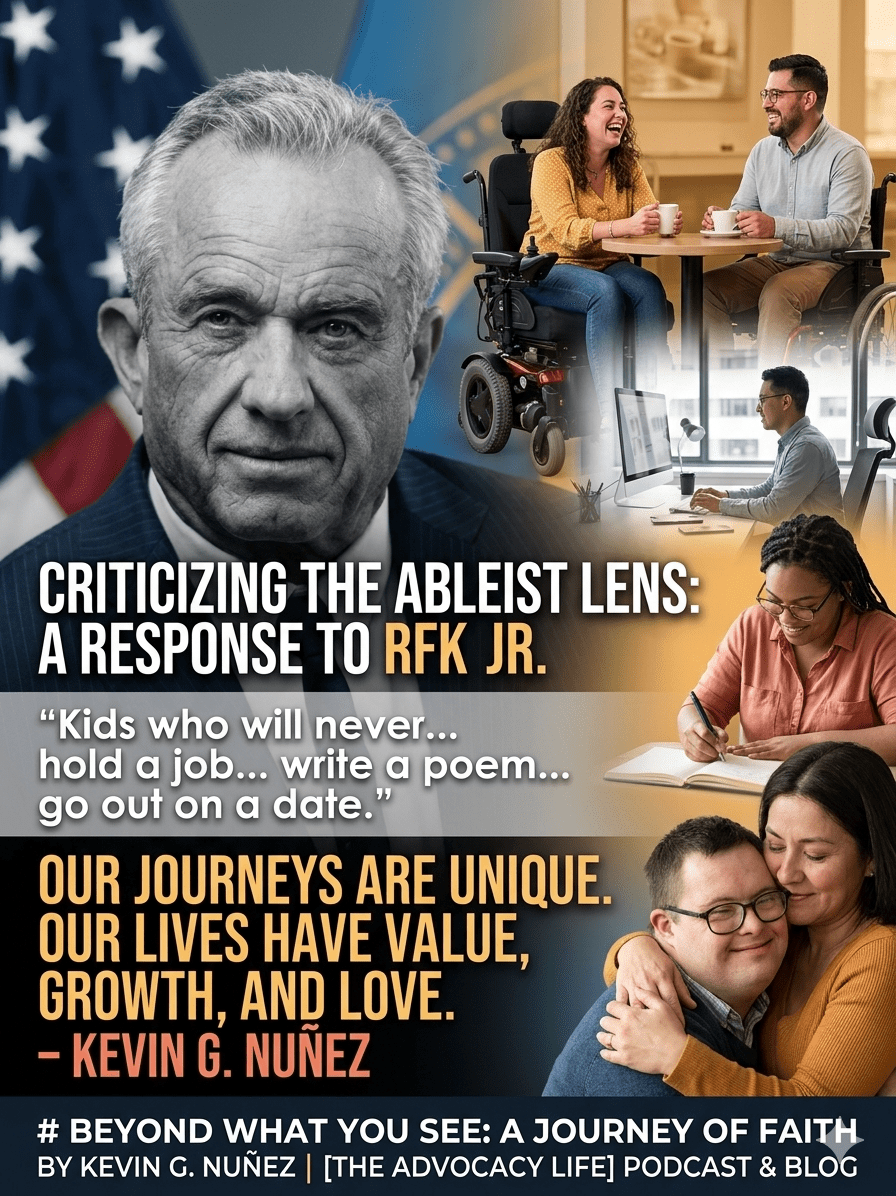
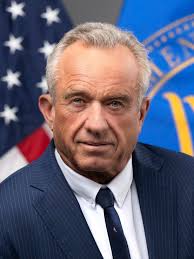
“These are kids who will never pay taxes. They’ll never hold a job. They’ll never play baseball. They’ll never write a poem. They’ll never go out on a date. Many of them will never use a toilet unassisted.” Robert F. Kennedy Jr.
I want to state from the outset: I don’t hate RFK Jr. I respect and love him as a fellow human walking this earth, despite disagreeing on several key issues. Quotes like these are particularly damaging. They embody the ableism and fear that permeate modern American culture.
The problem with this perspective is that it ignores the fundamental truth that every person with a disability has their own unique journey, their own growth process, their own setbacks, and their own successes.
So often, people with disabilities are lumped into boxes by a system that refuses to let them out. We are treated as if our lives are a “nice, comfortable jail cell.” We don’t realize that the door is a cell door until it gets slammed in our faces—and by then, it’s too late to get out.
RFK Jr.’s comments about dating are a prime example of the dehumanization we face. Just because someone may be non-verbal or have different physical needs does not mean they are unable to consent to or enjoy a loving, caring relationship. There are plenty of non-verbal individuals who have had rich, complex romantic lives—some of them having had more sexual encounters than I will ever have!
Society often measures our value by our productivity—by whether we pay taxes or hold a traditional job. With the new “Home and Community Based services HCBS” cuts coming to the nation in October 2026, many of us will be forced to choose between our health insurance and our ability to work.
We are forced to disclose our limitations and decide: Do we stay in poverty to keep our benefits, or do we risk it to earn a little bit of money? It is these societal norms that are damaging us, not our wants or our wills. We want to work—we want to work harder than most other Americans. We just need the real opportunities to do so.
Quotes like these don’t help anyone; they just hurt. If you want to help someone with a disability, don’t look for what you think they “can’t” do. Make them stronger, and they will make you better.
Don’t be afraid of us. Thrive with us. Push us. Educate us—because we can educate you in the same way. Together, we can learn from each other. That is what a good society does. That is what a good America does.
The other day I was going past some old writings something I do from time to time to see how I have improved. This was one of the first pieces i ever wrote as a blog almost 10 years ago. The subject matter is still relevant today. Hope you enjoy please share.
I wanted to raise awareness to a very big problem in our world today. It rarely gets any publicity; the average person doesn’t even know about it. The truth is unless you are affected by this problem, you don’t even know it exists. The problem is the lack of pay and benefits for direct support professionals (DSPs). What is a DSP? A direct support professional is someone who is paid through a provider agency or an individual to provide support and care to a person with a disability. As long as there are people who need assistance in their lives there will always be need for these professionals. There are four groups of people who are affected by this issue. They are: the individuals receiving the care, the family of the individual, the providers, and the professionals themselves.
Let me begin by addressing the individuals receiving the care. People that have a disability will learn that they often must depend on others to assist them in one way or another. They depend on the kindness of others to help them live their day-to-day lives. Could you trust someone with your most intimate tasks if you knew they would leave in six months? Just imagine knowing you’re going to lose the person you most confide in, even before they start. People with disabilities can tell almost immediately if the person is going to be good at their job. Most of all they can tell if the person will last.
Use your imagination for this next part please. You meet a person named Matt. After meeting him for only four hours, you need a shower. He must first undress you completely. Then he puts you in a shower chair. He then proceeds to give you a shower. Matt does his best to wash your private areas. After finishing and drying you off, he begins to dress you. If the individual is so fortunate, he can direct Matt on how and what to do. The truth is there are many individuals in the disability community that cannot speak for themselves. Therefore, Matt must try to interpret what they are trying to communicate. This is just one of the many duties of a DSP. I hope this brief example can illustrate the need for these very special people.
Next, I would like to talk about the direct support professionals themselves. These professionals receive about 10 to 11 dollars an hour with no promise of growth in their career. Most providers offer little to no benefits at all (this includes sick time or health insurance). As a result if DSPs don’t work, they aren’t paid. This leads to severe burnout. Many times, they sacrifice their own health and well-being to make sure they can provide for their family and/or pay their bills. It’s ironic that they are responsible for the health and well-being of another human when, due to the lack of health benefits such as sick days, they cannot take care of their own health needs. What inevitably happens is the person leaves to another company in hopes of a dollar more. People believe they can use this job as a steppingstone toward a larger career goal. The other misconception is this job will only be a temporary solution until another opportunity opens up. They end up living paycheck to paycheck. The professional waits in limbo until they burn out or they get another job.
So why would someone do this job at all? These wonderful people do it because they care for others. They look forward to the moments when their individual lights up when they arrive in the morning for their shift. The relationship between an individual and the professional is truly symbiotic if done correctly. The individual gets a companion to help them with their wants and needs. In turn the professional should receive joy in the knowledge they are doing something to help someone live their life. Some things are worth more than money. It is truly heartbreaking when it is time for the professional to move on. The best way I know to describe this feeling for an individual, it’s like losing a loved one. For the professional, they are left with the memories of a person that has worked their way into their hearts.
The family and/or parents of an individual can also be affected by the DSP issue. Try to imagine having a 25-year-old son that you have cared for his entire life. One day someone shows up at your door ready to take him out to the park for the day. You as the parent are told almost nothing about the person who will be supporting your child for the rest of the day. By the same token, the professional knows almost nothing about the individual and the family they will be supporting. Most times both parties are just given a name with a brief description. A relationship of trust has to be formed out of thin air. This sadly is one of the best-case scenarios. Most individuals as they get older lose their family and the professional becomes, by default, their brother, mother, etc. Depending on the individual’s disability, they will rely on their “families” in almost every way. They need an advocate, a caregiver, and a friend. Could you imagine learning to give your complete trust to a stranger every six months?
The final group of people that are affected by the DSP issue are the provider agencies. The turnover rate in this industry is incredibly high. Providers cannot keep their staff. They spend money training these professionals and then they quit a few months later. The money is lost. The rates for these staff and providers have not been increased in approximately 10 years. For example if the state allows $15 per hour to a provider, and $10 goes towards the DSP, that leaves the provider with only five dollars to spend subsequent overhead, including important items like gloves and vehicle maintenance. The providers cannot give their staff benefits or raises if they are barely able to keep themselves above water.
The direct support professional problem in my humble opinion has reached crisis levels not just statewide but nationally as well. As long as there are people, people will always need care. This industry is not going away any time soon. The system will never be perfect but something needs to be done now. This needs to be a call to action. We need to contact our state and federal officials to educate them on this very real problem. If we don’t act now people with disabilities may not have people around us to help us live our lives.
This week’s blog is going to be difficult for me to write. When I first started this project, it was meant to uplift my disability community and shed a light in this often dark world. I never want to bash anyone with a disability; our lives can be difficult enough. There is someone out there who is using various social media platforms to perpetuate negative narratives and victimize herself to gain fame and fortune. Alex Dacy, otherwise known as Wheelchair Rapunzel, is a disabled female living with Spinal Muscular Atrophy (SMA). She is not an influencer; she is seeking attention.
I used to follow her on TikTok and Instagram. I am not an influencer, nor am I judging her based on her disability. She makes me sad and angry because she has so many blessings but does not appreciate them. She should be an example for people with disabilities. Instead, she is an albatross for our way of life. In 1977, Judith Heumann the mother of the disability rights movement, was on the cover of Time magazine. In 2024, our community will see negative stereotypes reinforced because of people like Alex. You don’t have to take my word for it; I have a list of sources below that will let you see for yourself.
' “Watch out for false prophets. They come to you in sheep’s clothing, but inwardly they are ferocious wolves. 'Matthew 7:15
I feel it’s important for people with disabilities to support others. When I used to follow her, it was fun to see someone with a major disability going to the club and living their best life. After a few videos, her content got old fast for me because it reminded me of one of those guests on Jerry Springer. There is a medication called Spinraza that stops or severely slows the progression of her particular disability. The closest thing there is to a miracle drug. As long as it is taken daily. Alex calls it “twerk juice.” It does not take a rocket scientist to see that she is using other drugs or alcohol throughout the day. It is also clear that her content is monetized. Good for her.
On a recent podcast, she was asked about her adult entertainment site, which I never followed. Again, not a judgment on her. Individuals with disabilities have sex. However, she cannot claim that she had no other choice and she only did it to support her daughter., You cannot have your cake and eat it too. She is blessed with a beautiful daughter who is showcased frequently in her videos. Honestly, I forgot all about her until a few days ago, when I noticed our community was divided on whether to support her or not after she posted several videos victimizing herself for having Child Protective Services (CPS) make several visits to the home.
CPS harasses parents with disabilities. It is a sad right of passage for a new disabled mom or dad. This is not the case for Wheelchair Rapunzel and her baby’s father. They received home visits because they were high or drunk. The child is being neglected. Don’t take my word for it. Watch the videos for yourself. Her face is always bloodshot, and her partner” is smoking in the videos! One of the sources is an interview with one of her former caregivers. Alexis clearly needs counseling and to seek help. I do wish her the best, but right now she is not someone that should be followed or admired.
There are so many real disabled content creators and influencers who show their lives in the right way. Squirmy and Grubs a man with the same disability, have a YouTube channel with his wife. I commend them for the courage it took to document the struggle they went through trying to conceive a child. I know so many disabled couples who cry themselves to sleep, knowing they cannot have a child. So many men and women just happen to have some sort of disability that is constantly ignored because people don’t take the time to see their hearts. This world is so backward. All I can say is to investigate what you consume with your time and energy; don’t just watch something because it’s trending. As always, thanks for reading. I will see you next week.