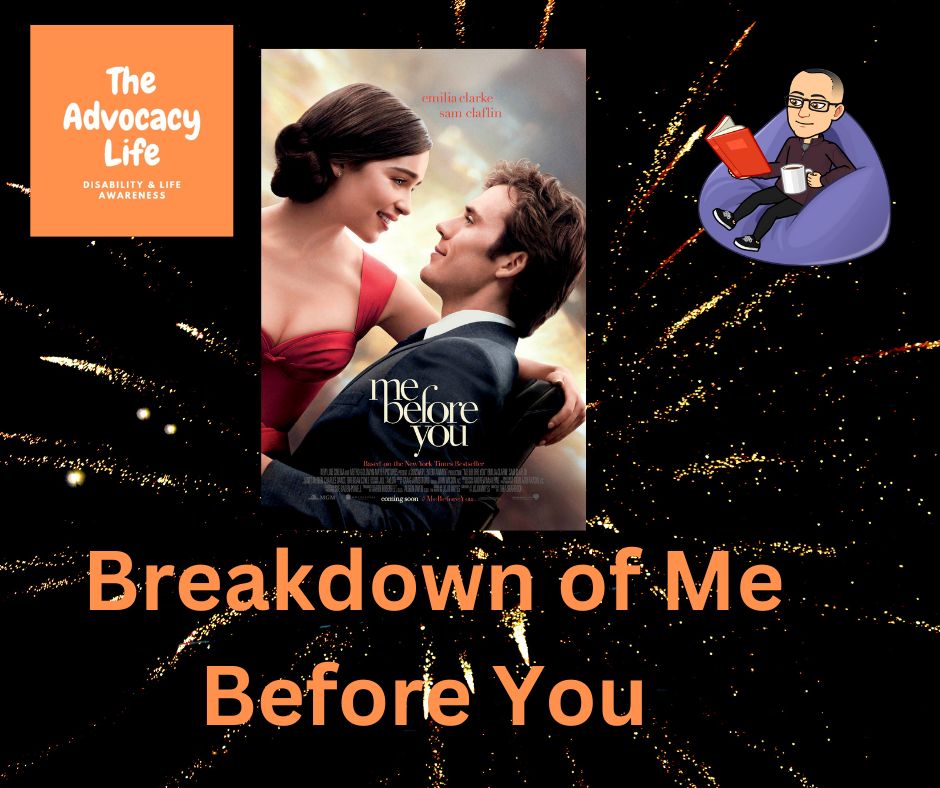
Is there a book you’ve read more than once? Don’t worry, this is not another shameless plug for my book. I’m going to talk about another book. Admittedly, I’m more of a movie buff than a bookworm. I can count the books I’ve read more than once on one hand. For me to do that, the book must stand out. I want to start a new series on my blog where I break down books and other sources of media featuring The disability community. I know this is not a new idea, but I never claimed to be original. For this first installment, I will be discussing the film and book Me Before You by Jojo Moyes I both love and hate this piece of fiction.
Please note that this book and film are over 10 years old, and I will be discussing spoilers. So, if you don’t want the ending ruined for you, come back and read this later Emma Clark, the female protagonist, is one of my celebrity crushes. The only reason I watched the movie in the first place was because I read the book after watching the movie. I am writing this before I purchase the audiobook. I am recommending this book and film. However, there are a few things you should know first.
Therefore we are always confident and know that as long as we are at home in the body we are away from the Lord. For we live by faith, not by sight. 2 Corinthians 5:6-7 NIV
Quick synopsis Will Traynor was once a very athletic and active young man before becoming paralyzed. His mother hires Louisa Clark to accompany him and perform some caregiving tasks, but not any of his private ones. Another caregiver looks after those. It is clear from the outset that the disabled character is depressed and missing his former life. As often happens in the beginning, they are both annoyed with each other before falling in love. After overcoming hardships and learning to trust each other with their most intimate life details, like a sexual assault that occurred to the female character, It is revealed that Will had planned and assisted suicide a year prior. Unfortunately, it does not end happily, as he follows through with those intentions.
Before I begin, I want to say I am not a paraplegic or quadrilateral. I was born with a disability. Every person is different, and every person living with a disability is different. It is not for me to say If the character is an accurate representation of a quadriplegic. I usually don’t enjoy first-person narrators. This is overused in young adult literature. Keeping this story from the point of view of Louisa not only keeps this story interesting, but it also serves as an educational piece to teach outsiders about disability. It’s okay to show that disabilities can be intimidating. Having a disability can be overwhelming at times The disability community does not serve to inspire the rest of society. No one with a disability is positive all the time. Struggles with mental health are real. People with all kinds of disabilities can have successful romantic relationships, even quadriplegics.
The idea that individuals with disabilities often harbor thoughts of suicide explains Will Traynor’s desire to end his life. This portrayal oversimplifies the complex emotions experienced by people with disabilities Just because someone has a major disability does not mean they wish to end their life. I truly believe that pieces of media like this unintentionally feed the idea That we should be put out of our misery. We are not dear on the side of the road. We are human beings with the same rights to live as anyone else.
Another stereotype the book addresses is the belief that love cannot flourish in a relationship involving a disabled person. Louisa and Will’s connection is depicted as profound and heartfelt. However, the story inadvertently hints that love can only exist in the face of pity and tragedy when one has a disability. This portrayal undermines the possibility of genuine love in such relationships.
Literature like this can inadvertently propagate negative stereotypes. When books consistently depict individuals with disabilities as trapped in despair, they reinforce biases and restrict opportunities and expectations. As responsible readers, we should approach such stories with a critical perspective and use them as a starting point for conversations that challenge these stereotypes. By doing so, we can contribute to a more inclusive society where individuals with disabilities are recognized for their unique strengths and abilities rather than being confined to harmful clichés.
Sources:
https://www.jojomoyes.com/books/me-before-you/
Disability Limbo Newsletter
I started Letters from the Limbo as a way to connect with you on a deeper level. Twice a month, I send out an email filled with personal anecdotes, professional updates (like my recent reelection as Vice Chair of the NJCDD), and the policy insights I don’t share anywhere else. This isn’t just another email—it’s an unfiltered look at the life of a disability advocate. Join my community and get an exclusive, honest look at the work that matters


 The Advocacy Life Podcast & Blog
Leave a comment