Happy Thursday friends. I’ve had a very troubling week. I know today is Thursday but since my podcast was released on the 15th which fell on a Wednesday I decided to push this back a day Have you ever woken up feeling like everything’s just wrong? Like the whole world’s against you? It’s something we all feel sometimes. But have you ever stopped to wonder why? Is it because the world’s just messed up, or is there something about us that needs fixing?
I’ve always been someone who sees the bright side of things. Even when it seems like everyone’s complaining about what they don’t have, I try to focus on what’s good. Sure, there’s a lot of bad stuff out there—violence, discrimination, you name it. But that’s not what I want to talk about.
What bugs me is how we complain about every little thing just because our lives aren’t perfect. In this post, I want to compare some common complaints with my own experiences. Not to moan and groan, but to show that even when life’s tough, there’s still plenty to be thankful for.
1 Thessalonians 5:18 NIV [18] give thanks in all circumstances; for this is God’s will for you in Christ Jesus.
Let’s start with feeling tired. We’ve all been there, right? Wanting to stay in bed a little longer. But for me, getting out of bed isn’t so simple. Every morning, I need someone to help me, which makes me see tiredness in a whole new light.
Then there’s the whole job situation. Feeling like you’re not making enough money, hating your job—sound familiar? It’s something I’ve felt too. But for me, the biggest challenge isn’t my disability—it’s the money struggles that come with it. The day I get my first paycheck? It’s gonna be a big deal, let me tell you.
And traffic? Don’t even get me started. As someone who can’t drive because of my disability, I rely on public transport. And let me tell you, it’s not always smooth sailing. What might be a quick trip for someone else can turn into an all-day ordeal for me.
I could go on and on, but you get the idea. We need to stop taking things for granted and start appreciating what we have. As they say, one person’s trash is another person’s treasure. Instead of always wanting more, let’s learn to be happy with what we’ve got. So, I hope reading this makes you see things a little differently. Thanks for reading, and feel free to share your thoughts in the comments below.
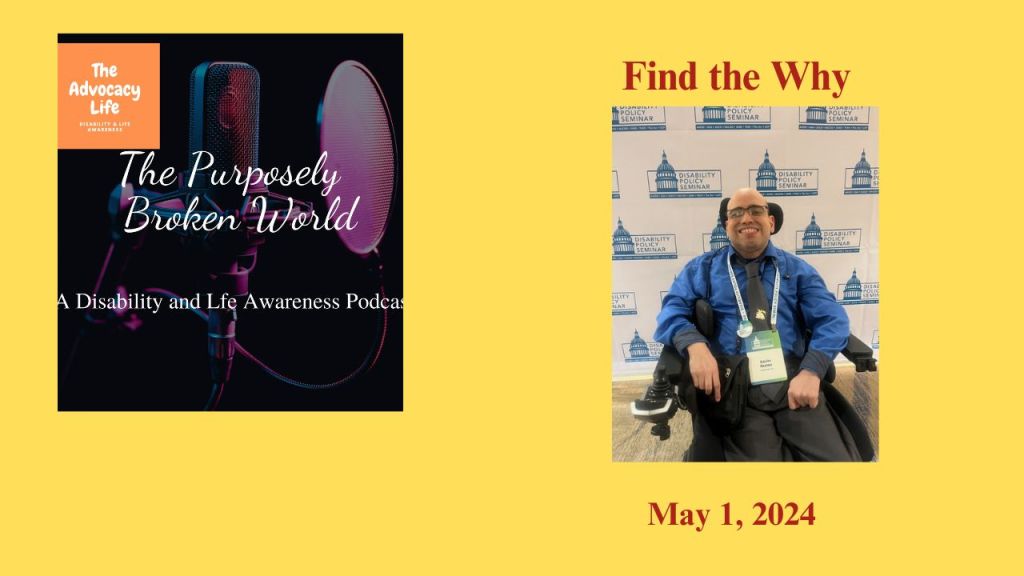
In the May 15, 2024 episode of The Purposely Broken World podcast, Kevin Descilson talks about how perseverance can be a superpower, even in the face of disability. He discusses the importance of making the best of a bad situation and emphasizes that having the right perspective is key to maintaining a positive attitude. Don’t forget to share and encourage your friends to subscribe!
My legs were burning when I went to bed the other night, but I was content despite having a sore back. I was on my laptop or tablet from 11:00 in the morning until 11:30 at night. My brother asked several times, “Are you done yet? Where is your finish line? Something has to be said so someone else can finish the job that people before me started. I must issue a favorable warning before continuing. I might make some unjust comparisons in the course of this writing. It is not to offend anyone; it is simply an illustration point.
Philippians 3:13-14 NIV “Brothers and sisters, I do not consider myself yet to have taken hold of it. But one thing I do: Forgetting what is behind and straining toward what is ahead, I press on toward the goal to win the prize for which God has called me heavenward in Christ Jesus.”
The work I do to advocate for those with disabilities is not for me; it’s for someone in the next generation. So they don’t have to fear society and not be seen as equal by their peers, whether they have a disability or not. People don’t want to admit this, but there are people out there who want people with disabilities dead after a certain age. After they stop being cute, we need a social movement to make it okay for people with disabilities to live and thrive in their communities. Home and Community-Based Services (HCBS) is a great concept and it will lead to system change eventually. Parents of a disabled child should never have to fear the day they can no longer be there for their child. Working with those who are the most vulnerable cannot be seen as a dead-end job. It needs to be seen as a fulfilling career. To use an antiquated term, this has to stop being ‘pink-collar work.’
Speaking of work, those of us who should be working should be offered better jobs than greeters at Walmart or in the back of a restaurant washing dishes. Do our hands have to shake when we hand our resumes to a potential employer? The first concern of an employer should never be, “How much is it going to cost to accommodate you to work here? We have to stop being inspirational just for going to college. I know so many individuals who have finished their college degree but cannot find meaningful employment because they need their health benefits.
FDR
"In these days of difficulty, we Americans everywhere must and shall choose the path of social justice—the path of faith, the path of hope, and the path of love toward our fellow man."
The LGBTQ+ community fought for several years to have marriage equality. I am sorry to say this but we still don’t have marriage equality because people with disabilities are still penalized for wanting to get married. I feel like there is a false illusion that if people with disabilities had children, it would be more of a burden on our society to take care of them. Most disabled parents are more loving and caring than able-bodied parents. Yes, they will need more support but that means more jobs and more opportunities for people to see us as part of their local communities. People like me who look different should not be ashamed to be on a dating app. People don’t understand what it’s like to be afraid to talk to a pretty girl. Imagine what it would be like not being able to talk at all to that same girl.
People with disabilities are currently in financial and social slavery! Brad Lomax and Judith Heumann did their part. A generation later, the Americans with Disabilities Act (ADA) was a gigantic step forward. As a community, we need to come together and stop letting society divide us.
I will continue to work with the system so that one day someone can either emotionally, mentally, or physically stand up for others. I’m proud to be a nobody. My name will not go down in history books. I work so that one day someone can get married without fear. I work so a mother will not have to cry when they have to hand over the care of their child to someone else. I work so that one day someone you know using a wheelchair will not be seen as an inspiration when they are the CEO of a Fortune 500 company. This may not make sense to a lot of people, but one day it will.
Disability does not care what color you are on the outside. Your sexual orientation is of no consequence. Your political views are irrelevant to people with disabilities. The disability is just part of the person, not the whole person. I know I said all this before on other blogs. I probably sound like a broken record. I’ve never asked my small audience for anything, but I asked that you please share this with someone who has no concept of disability. To someone who thinks we are less than. We are not lost. We are the ones who are strong because we value life, cherish our blessings, and take advantage of the opportunities we’ve been given. We might be broken on the outside, but some are even broken on the inside. we understand that our lives have meaning. Sometimes it’s better to have a life of struggle with a great ending than to have a life without knowing or wanting the destination because you’re searching for the illusion of perfection.
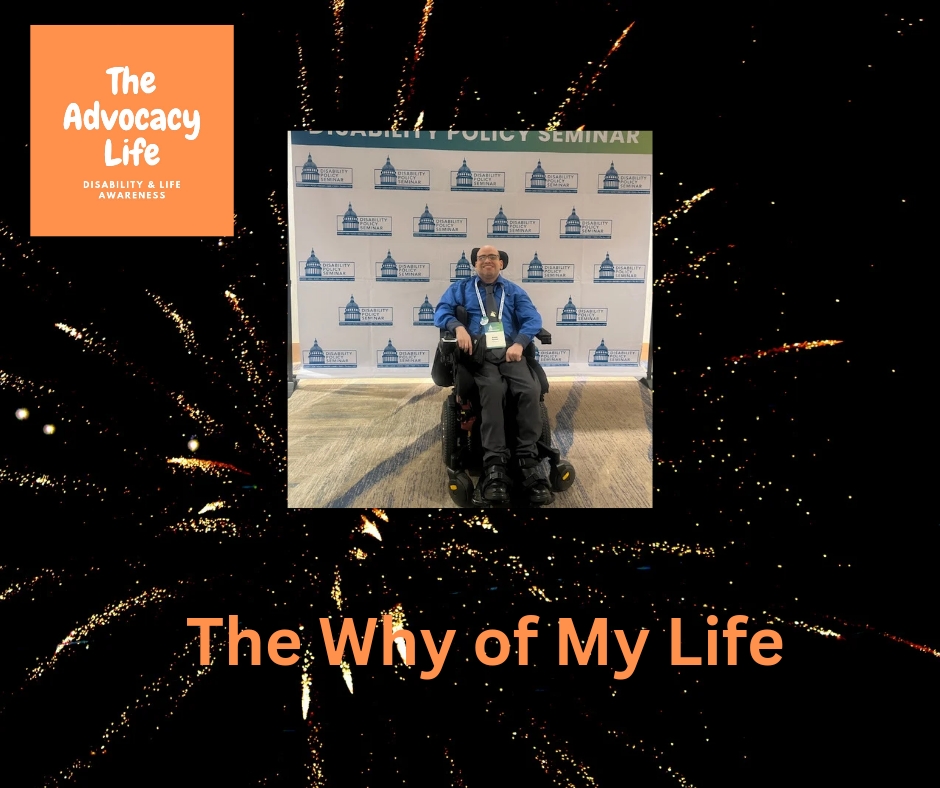
So often, we don’t know why we do the things we do in life. In the second episode for April, Kevin discusses why he does what he does for others. It’s not always easy or fun to sacrifice yourself for someone you don’t know but it can be worth it. Please share and subscribe to this very passionate podcast.
The other day I was asked, “Why do you choose to volunteer and advocate for others instead of looking for a paid job?” this is very simple yet complex question, at least for me. It made my heart so joyful to answer this question. I wish I could tell you I remember exactly what I said, but now that I’ve had some time to think about it, I want to give the real answer. I didn’t lie to the person who gave me the interview; I just didn’t go into a lot of detail.
The short answer is that I cannot get paid because I would lose my social security, which I need to live In addition, I am the vice chair of the New Jersey Council on Developmental Disabilities, and according to the bylaws, we are not allowed to make a profit from this position. The same goes for my position with SABE, a national advocacy board for individuals with disabilities. My days are long, but I could not be any happier.
People will never understand this, but my disability is not a curse or punishment from God. It is a platform to be the voice for others who have no one to fight for them. The other day, I had to meet with a congressman’s staff. They made me sit at the head of the table because someone else mentioned,’ Kevin had to go first; he is the rock star. I quickly corrected that I was just a nobody. I could not believe what I was doing. That night, I went to bed with tears in my eyes and a full heart.
Ephesians 2:8-9 NIV [8] For it is by grace you have been saved, through faith—and this is not from yourselves, it is the gift of God— [9] not by works, so that no one can boast.
A Disability advocates do not get a lot of women. I do not look good on dating apps. The most money I’ve made was a gift card for doing something unofficial for a colleague. My body always hurts at the end of the day it can be lonely because most of the time I’m the only disabled person in the room. Sometimes I do feel the weight of a community on my shoulders. When I have these moments I look to my Bible. I don’t have any weight on me because someone else is holding up for me. I’m just a tool. Do I deserve to be this tool?
No, I don’t. I don’t deserve any blessings. I’m sure I have days when I’ll complain. at the end of each day, I remembered to be grateful because I Was chosen to do the work of my big brother Jesus. That is wonderful! Friends, don’t get so caught up with your narrow view of the world that you forget to look at the big picture. There’s always someone that needs help. Make sure you do your part. Thanks for your time see you next week.
This week’s blog is going to be difficult for me to write. When I first started this project, it was meant to uplift my disability community and shed a light in this often dark world. I never want to bash anyone with a disability; our lives can be difficult enough. There is someone out there who is using various social media platforms to perpetuate negative narratives and victimize herself to gain fame and fortune. Alex Dacy, otherwise known as Wheelchair Rapunzel, is a disabled female living with Spinal Muscular Atrophy (SMA). She is not an influencer; she is seeking attention.
I used to follow her on TikTok and Instagram. I am not an influencer, nor am I judging her based on her disability. She makes me sad and angry because she has so many blessings but does not appreciate them. She should be an example for people with disabilities. Instead, she is an albatross for our way of life. In 1977, Judith Heumann the mother of the disability rights movement, was on the cover of Time magazine. In 2024, our community will see negative stereotypes reinforced because of people like Alex. You don’t have to take my word for it; I have a list of sources below that will let you see for yourself.
' “Watch out for false prophets. They come to you in sheep’s clothing, but inwardly they are ferocious wolves. 'Matthew 7:15
I feel it’s important for people with disabilities to support others. When I used to follow her, it was fun to see someone with a major disability going to the club and living their best life. After a few videos, her content got old fast for me because it reminded me of one of those guests on Jerry Springer. There is a medication called Spinraza that stops or severely slows the progression of her particular disability. The closest thing there is to a miracle drug. As long as it is taken daily. Alex calls it “twerk juice.” It does not take a rocket scientist to see that she is using other drugs or alcohol throughout the day. It is also clear that her content is monetized. Good for her.
On a recent podcast, she was asked about her adult entertainment site, which I never followed. Again, not a judgment on her. Individuals with disabilities have sex. However, she cannot claim that she had no other choice and she only did it to support her daughter., You cannot have your cake and eat it too. She is blessed with a beautiful daughter who is showcased frequently in her videos. Honestly, I forgot all about her until a few days ago, when I noticed our community was divided on whether to support her or not after she posted several videos victimizing herself for having Child Protective Services (CPS) make several visits to the home.
CPS harasses parents with disabilities. It is a sad right of passage for a new disabled mom or dad. This is not the case for Wheelchair Rapunzel and her baby’s father. They received home visits because they were high or drunk. The child is being neglected. Don’t take my word for it. Watch the videos for yourself. Her face is always bloodshot, and her partner” is smoking in the videos! One of the sources is an interview with one of her former caregivers. Alexis clearly needs counseling and to seek help. I do wish her the best, but right now she is not someone that should be followed or admired.
There are so many real disabled content creators and influencers who show their lives in the right way. Squirmy and Grubs a man with the same disability, have a YouTube channel with his wife. I commend them for the courage it took to document the struggle they went through trying to conceive a child. I know so many disabled couples who cry themselves to sleep, knowing they cannot have a child. So many men and women just happen to have some sort of disability that is constantly ignored because people don’t take the time to see their hearts. This world is so backward. All I can say is to investigate what you consume with your time and energy; don’t just watch something because it’s trending. As always, thanks for reading. I will see you next week.