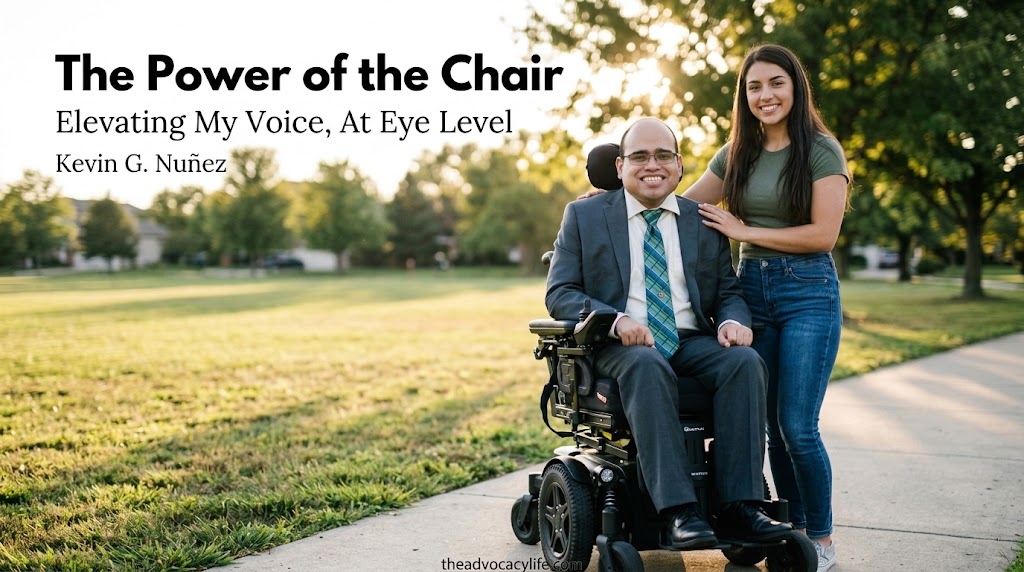
School starts after Labor Day in New Jersey, and as a kid, that always meant new clothes, new school supplies, and a brand-new wheelchair. This year was different. My new chair didn’t arrive until March.
The price tag on the chair I’m sitting in to write this? Nearly $60,000.
When you hear a number like that, it’s easy to do some dark math. Is $60,000 the price tag on my independence? Am I worth $60,000? Why does basic human mobility cost as much as a luxury sedan? That’s an algorithm for insurance companies and policymakers—a topic that usually sits above my advocacy pay grade. But here’s what I can tell you: this technology keeps me from being confined to a bed. It would feel unlivable. With it, I can roll out into the world, make my voice heard, and face life head-on.
For years, living in a wheelchair meant existing in a world built for vertical people. Everyone else’s chest or waist was where I always saw the world from. But this new chair comes with hydraulic elevation.

Not long ago, I was at a bar with high-top tables where everyone was standing. Typically, I’d be at a huge disadvantage, craning my neck up just to participate in the conversation. This time, I hit a button on my joystick, elevated my seat, and held a conversation at true eye level. For the first time, I wasn’t being talked down to—literally or figuratively. That single moment alone was worth the price of admission.
Since I spend at least six to eight hours a day in this chair, I’ve learned a thing or two about how the rest of the world interacts with mobility devices. For those of us who use them—and for the non-disabled allies reading this—here are a few basic ground rules:
- Running someone over with a wheelchair isn’t a funny prank like in the movies; it’s the exact equivalent of hitting someone with your fist. Treat a person’s mobility equipment with the same respect you’d treat their personal space.
- Wheelchairs are highly technical, custom-built, and absurdly expensive. Well-meaning people often try to grab the handles or push without asking. You could easily damage the chair or throw off the user’s balance. Always ask first.
- Bodies break down, and chairs break down. They collect dust, weather, and yes, the occasional stray French fry in the cushions. Keeping a chair clean is part of the routine of staying functional.
A chair can feel restrictive at times, but so can any human body. Ultimately, it isn’t a cage; it’s a platform. It’s the tool that lets me show up to council meetings, write books, host my podcast, and advocate for our community.
Your mobility device doesn’t define your worth, but it can certainly amplify your power. Take care of your gear, demand respect for your space, and never let anyone talk down to you—no matter what height you’re sitting at. Keep on rolling. Keep on living.

The Podcast
Published Books
Subscribe to Letter from Limbo
Read more of this content when you subscribe today.
Make a one-time donation
Make a monthly donation
Make a yearly donation
Choose an amount
Or enter a custom amount
Your contribution is appreciated.
Your contribution is appreciated.
Your contribution is appreciated.
 The Advocacy Life Podcast & Blog
Leave a comment